Share this post
related content
The Philippines’ anti-drug campaign, commonly known as the ‘war on drugs’, has been marked by thousands of deaths, extrajudicial killings and serious human rights violations.
Far less examined, however, is the financial architecture that enabled and sustained this response: where the funds came from, how much was spent, where resources flowed and what these funding patterns reveal about the priorities of the country’s former and current drug policy.
This brief addresses these questions. It is based on a study led by Harm Reduction International and Nobox Philippines which analysed publicly available budget documents, public records, donor data and other literature relating to the Philippine government’s drug policy between 2015 and 2024.
At its core, this report is about more than money. It is about how public funds are being used to build, sustain and legitimise how the Philippines treats many of its citizens in the name of the ‘war on drugs’.
National government allocations on drug response
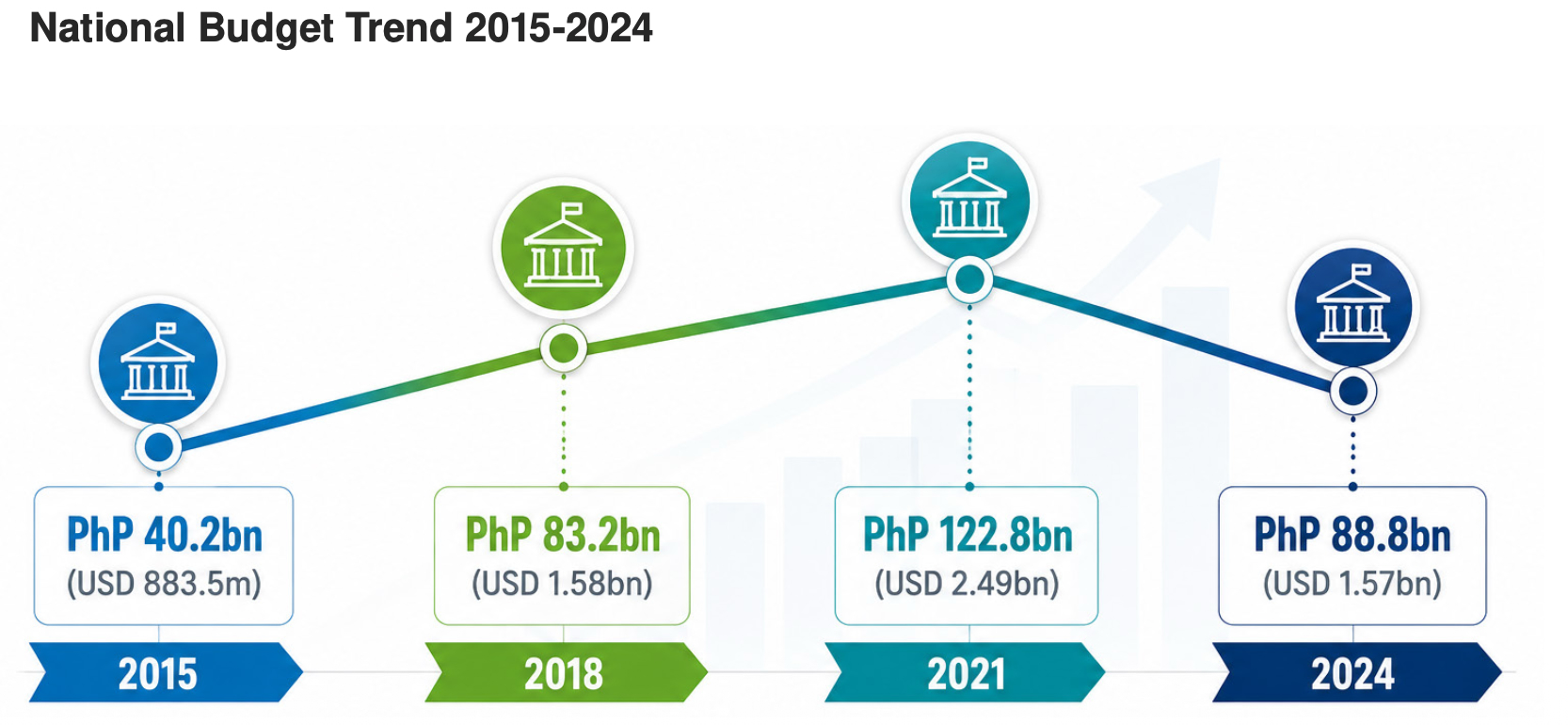
- The Philippine’s national drug-response budget more than doubled between 2015 and 2024. It peaked in 2021 at an estimated PhP 122.8bn (USD 2.49bn); an increase of over 200% compared with 2015.
- The national budget figures show a drug response still anchored in criminalisation.
- The largest shares (89% of total budget on drug response) flow to police, jail, correctional and legal systems.
- 5% of the total drug-response budget – went on health, social and livelihood programmes, the effectiveness of which have not been publicly documented.
Local government budget allocations on drug response
- In 2024, the overall local government peace-and-order budget was PhP 4.9bn (USD 93.3m). Of this total, 97% of total budget was programmed for ‘anti-illegal drugs’ activities.
- Budget data from 2024 reflects a continued and substantial investment in punitive and enforcement-based approaches, despite an official shift toward rehabilitation.
- Public money is helping to entrench local government practices that blur care, control and surveillance in everyday community life.
- Local allocations do not appear to correspond to general population sizes (and, by extension, levels of drug use in that area)
Foreign assistance (aid) budget on drug response
- Between 2015-2023, foreign assistance for the Philippine’s drug response was approximately USD 90.9m (PhP 3.78bn); an average of almost USD 10m per year.
- US foreign assistance heavily prioritised law enforcement and drug-free aims over health. 99% of total assistance- funded law enforcement and criminal legal systems, while only 0.87% funded health responses.
- China funded at least USD 15m in infrastructure or ‘hard’ projects, primarily drug treatment and rehabilitation facilities, which take an abstinence, detoxification-focused approach and offer little or no evidence-based harm reduction; including additional USD 28.11m (PhP 1.5bn) for ‘mega-rehab’ centre housed in a military camp in Nueva Ecija, funded by a Chinese tycoon.
- Japan’s drug-control financial assistance amounted to USD 14m (PhP 770m). It mainly focused on ‘health’ initiatives, including the construction of a treatment and rehabilitation centre, which was awarded to a Japanese contractor and again took an abstinence, detoxification-focused approach.
- South Korea provided over USD 6m (PhP 330m) for PNP capacity-building, narcotics crime investigation and marine security.
- Australia funded a Transnational Organized Crime Threat Assessment to support agencies countering organised crime and drug trafficking.
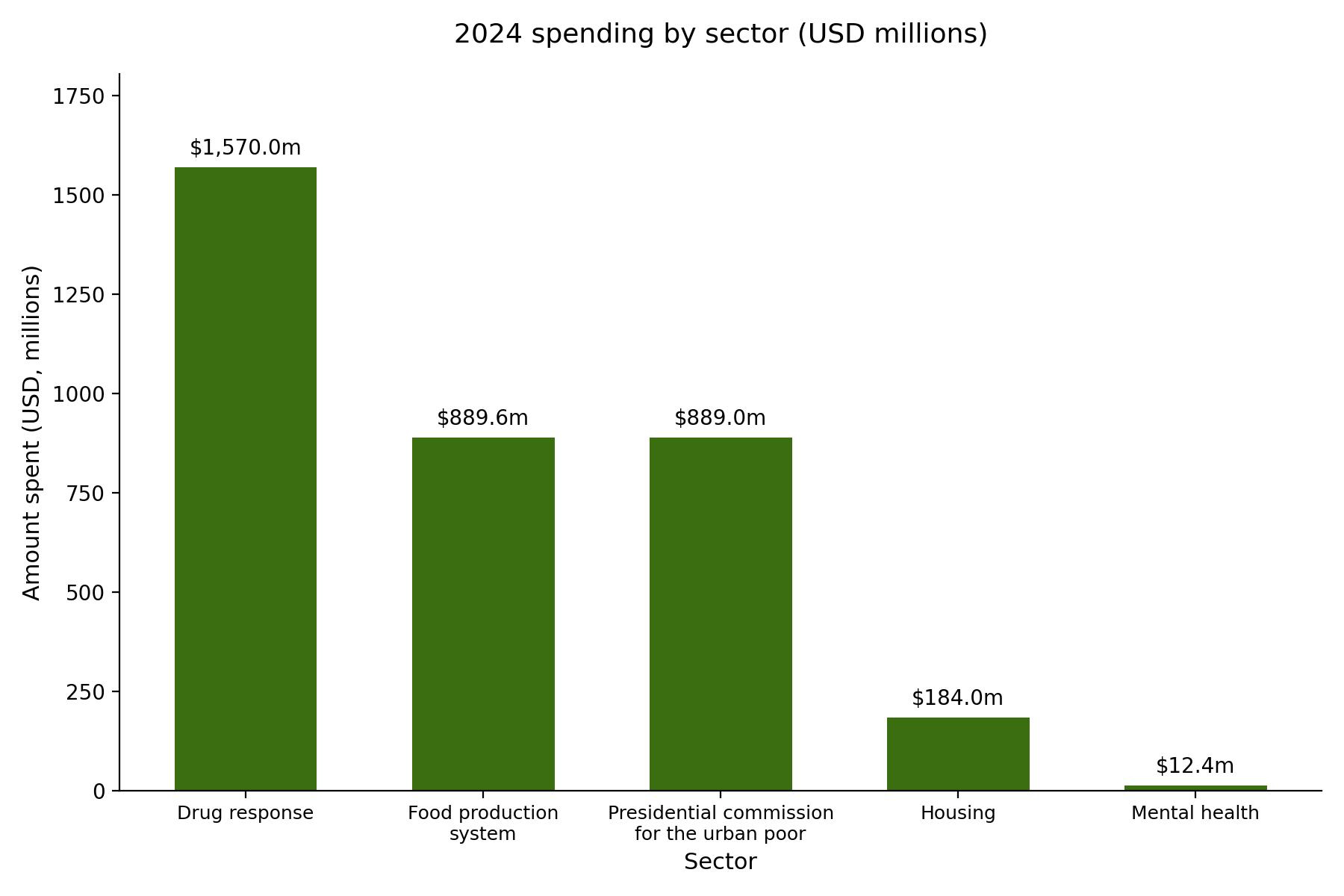
Government spending on the drugs response compared with other related development sectors: 2024
Recommendations
Recommendations for the Philippine government
- Make drug response/policy financing visible and transparent. Establish a drug-response budget tagging and reporting system.
- Revise PADS (Philippine Anti-Illegal Drugs Strategy) and related indicators so success is no longer measured through drug-free targets.
- Review local anti-drug budgeting under POPS (Peace and Order and Public Safety) plans and ADACs (Anti-Drug Abuse Councils) to ensure measurable health and social support outcomes.
- Strengthen accountability for public funds and people directly affected by drug policies by
- Commissioning an independent review of drug policy financing, programmes and outcomes.
- Building independent grievance and redress mechanisms into drug-related programmes.
- Ensuring safe and meaningful participation of
- Rebalance funding towards voluntary, community-responsive health and social support.
Recommendations for donor governments and multilateral actors
- Publicly disclose all drug-related assistance to the Philippines including evaluation findings of such assistance.
- Adopt and publish clear human rights guidelines and conduct due diligence before funding drug-related programmes.
- Do not fund programmes that reinforce punitive or surveillance-heavy drug responses.
- Redirect assistance toward harm reduction, voluntary services and community-led support.
Don't miss our events and publications
Subscribe to our newsletter